
Your needs, this model
Does it fit your priorities?
How does Hypervolt Plus Bluetooth differ from the regular Hypervolt Bluetooth?
The maker's support specs list a 90 W motor, 3 lb body and 81 dB rating for Plus versus 60 W, 2.5 lb and 79 dB for the regular version; both pages list three levels, five standard head shapes and Bluetooth. These are published specifications, not comparative performance or noise tests.
Explore this need in the finder →Does the Plus have a documented carrying case?
The support specifications name five standard attachments but do not state a carry case or pouch. The kit field remains unknown, so it cannot satisfy a must-have case filter without exact offer evidence.
Explore this need in the finder →What safety and charger checks matter on a used Plus?
Hyperice's safety instructions require the model-appropriate 24 V charger, light moving use on dry soft tissue, stopping at pain, and consulting a physician under the listed contraindications. The company also distinguishes older first-generation 26 V hardware; inspect the actual model and charger label rather than substituting a similar plug.
Explore this need in the finder →Does original-generation Hypervolt Plus Bluetooth fit the same earlier full-size no-heat runtime/noise screen when the weight ceiling rises to 1,400 g?
The Plus support specification lists a 3 lb body (about 1,361 g), five standard heads, approximately 2.5 hours of battery life and an 81 dB rating. It misses the 1,350 g ceiling but qualifies at 1,400 g in this source-publication scenario. The maker does not state installed-head basis or noise test conditions, so this is neither packed mass nor a comfort or measured-sound claim.
Explore this need in the finder →The Hypervolt Plus Bluetooth is the heavier, higher-wattage original-generation sibling of the standard Hypervolt Bluetooth. Hyperice's declaration of conformity identifies the exact name and model/reference 54020 001-00; its US support specification page lists a 90 W motor, 3 lb body, 81 dB rating and approximate 2.5-hour battery claim. This is an earlier-model assessment for identification and comparison, not a statement that a new US retail offer remains available. The exact declaration and manual were downloaded from Hyperice; the support specification and safety pages were viewed in the manufacturer's help center because direct retrieval returned 403.
Where the Plus differs
The published spec sheet calls the Plus a three-speed, full-size device with five standard heads: Fork, Bullet, Flat, Cushion and Round. It lists 30, 40 and 53 Hz, a 90 W brushless motor, Bluetooth, pressure feedback, 3 lb (about 1,361 g) device weight and an 81 dB rating. For comparison, the support page for the regular Hypervolt Bluetooth lists a 60 W motor, 2.5 lb body and 79 dB. Both pages list three levels and the same five head shapes. This is a careful comparison of maker-stated fields only; wattage is not a test of usable force, the small dB difference is not a controlled sound comparison, and neither number predicts comfort.
The Plus support page does not provide a measurement setup for 81 dB. There is no stated distance, room, head, setting or meter protocol. It qualifies for a filter asking whether Hyperice publishes a numeric dB rating, but a visitor should not read that number as a quietness guarantee or a measured ranking against other products.
There is also an exact-spec conflict on the PPM detail. The support specification reports 2,400, 2,800 and 3,200 percussions per minute at 30/40/53 Hz; the manual lists 1,800, 2,400 and 3,180 at those same frequencies. Because the sequence differs, I preserve the conflict and do not make a comparison from one chosen PPM list. The support page and manufacturer manual are both primary references: Plus specifications and the English manual.
Operation and kit uncertainty
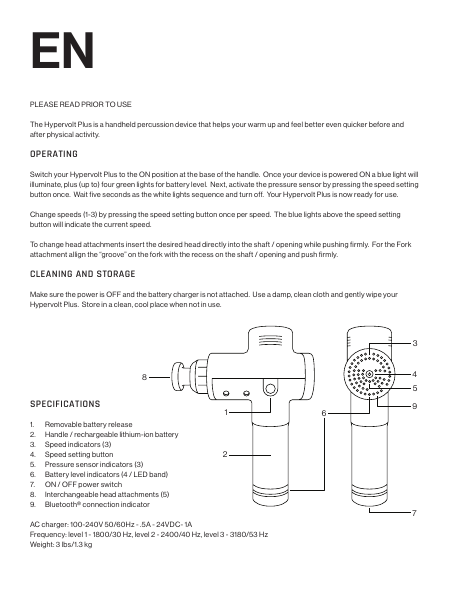
Hyperice's operating instructions describe a switch at the bottom of the battery and a button that cycles through levels one to three. The Plus has a removable battery, and the manual diagram shows its controls and Bluetooth indicator. The unit can be operated directly; the app connection is an additional route, not a prerequisite for selecting a speed. Stop the attachment before pulling it out, then push the replacement head firmly into the shaft. The five named shapes are useful for understanding the documented kit, but the support specification is not a complete retail packing list.
Most importantly, the sources checked do not say whether every Hypervolt Plus Bluetooth package included a full-gun case or attachment pouch, nor do they identify the exact adapter set. That omission remains unknown rather than a conclusion that no package ever included one. If portability or a protective case matters, require a photo or written inventory for the particular offer. Do not count a head pouch as a gun case unless the package says so.
Battery, charging and age
The support page publishes approximately 2.5 hours of battery life. Hyperice does not give a Plus-specific use-condition breakdown in the reviewed materials, and this is not an independent run-time result. A battery in an older used unit may behave differently; no battery-capacity number or service-life promise was located here.
Charger instructions conflict across original-generation Plus sources. The official Plus safety page specifies the supplied 24 V charger, but the Plus manual names a 26 VDC adapter (SK03T1-2600100W2 or MX24D2-2601000). The support specification and current charger FAQ also describe 24 V guidance while noting first-generation 26 V equipment and compatibility. These are not a serial-specific adapter match. For a used Plus, do not resolve the conflict by connector fit alone: check the gun label and adapter output, consult Hyperice if the records disagree, and do not charge an unidentified unit. The safety source also says not to leave the device unattended while charging and to unplug before use.
Safe-use limits matter more than the “Plus” name
The manufacturer's safety instructions describe light, moving contact on dry soft tissue, about 60 seconds per region, and stopping promptly for pain or discomfort. Avoid hard or bony areas, the head, bruises and injured or irritated skin. Its listed physician-consultation cautions include pregnancy, certain diabetes complications, pacemakers, recent surgery or injury, some spinal conditions and implanted metal. The support page also warns that bruising can occur at any pressure setting. Those are the company's general instructions, not a clinical clearance for an individual; talk with a qualified clinician if any caution applies to you.
Bottom line
For a shopper identifying an older Hyperice unit, the documented differences are straightforward: Plus Bluetooth is listed at 90 W, 3 lb and 81 dB versus the regular Hypervolt Bluetooth at 60 W, 2.5 lb and 79 dB. Both are three-speed Bluetooth models with five named standard heads. The Plus may suit a comparison where those published fields matter, but it is heavier and the specification numbers do not establish tested effectiveness. Its exact case, package and used-unit battery condition remain unverified, and the conflicting PPM values should not be repeated as settled facts. Confirm 54020 001-00, the actual five-head contents, the charger label and seller return terms. The page image is a diagram rendered from Hyperice's manual, not a retail photograph or package inventory.
Key specifications
Key details at a glance
| Manufacturer SKU surfaced in source | 54020 001-00 |
|---|---|
| Body format | Full size |
| Device body weight (where precise enough to compare) | 1361 g |
| Speed-setting count (unknown if conflicted) | 3 |
| Heads listed in the kit | 5 |
| Heads listed in the kit | Fork / Bullet / Flat / Cushion / Round |
| Heated massage head listed in kit | No |
| Current product-page runtime claim | 150 min |
| Manufacturer dB rating present | Yes |
| USB-C charging listed | No |
| Heat built into gun body | No |
Use the exact model’s instructions for operating limits, supplied equipment and version differences.
Sources for this review
Sources for this assessment
- Hypervolt Plus Bluetooth official declaration of conformity
- Hypervolt Plus official US support specifications
- Hypervolt Plus official US operating instructions
- Hypervolt Plus official US safety instructions
- Hypervolt Plus official multilingual product manual, English pages
- Which charger should I use with my Hyperice product?
- CPSC Recall & Product Safety Warnings search
Check the fit against your priorities
Use the finder to compare documented features, then review the exact package and caveats.