
Your needs, this model
Does it fit your priorities?
What attachment shapes does the Hypervolt Bluetooth specification list?
The manufacturer support specification names Fork, Bullet, Flat, Cushion and Round. It does not list a heated head among those five; verify any seller's package because the original retail-box list was not located.
Explore this need in the finder →Does Hypervolt Bluetooth have a published numeric noise rating?
Yes. Hyperice's support specifications publish 79 dB, but provide no distance, setting, room or measurement protocol; it is a manufacturer rating, not an independent noise test.
Explore this need in the finder →Can I assume an old Hypervolt Bluetooth includes a carrying case?
No. The reviewed support specification lists heads but does not document a case or pouch. That package field stays unknown, so this record does not satisfy a must-have included-case filter; check the exact used or retailer package.
Explore this need in the finder →Does original-generation Hypervolt Bluetooth fit a full-size, earlier, no-heated-head comparison with published runtime and noise claims at a 1,150 g ceiling?
The official specification/manual describe a full-size 2.5 lb body (about 1,134 g), five standard heads and a published 79 dB rating; the spec says approximately three hours and the operating guide qualifies average runtime as 2+ hours depending on speed and pressure. It fits this source-publication filter at 1,150 g but not 1,100 g. These are not independent sound or endurance tests, and the weight is not a packed-kit measurement.
Explore this need in the finder →The Hypervolt Bluetooth is an earlier, full-size Hyperice percussion gun, not the newer Hypervolt 2, Pro, or compact Go family. A manufacturer declaration of conformity gives the exact model/reference as 53100 038-00; the legacy US support specifications describe a silver-and-black Hypervolt with Bluetooth, five heads, pressure feedback and three speeds. I treat that pairing as a documented historical configuration, not evidence of current stock. The official support pages were viewable in the manufacturer's help center, but direct page downloads returned 403; the English manual and exact Bluetooth declaration were retrieved as files.
What the maker documents
The US support specification lists a 60 W brushless motor, three speed levels at 30, 40 and 53 Hz, a body weight of 2.5 lb, five head shapes—Fork, Bullet, Flat, Cushion and Round—and built-in pressure-sensor feedback. It also names Bluetooth and publishes a 79 dB rating. These are catalog specifications, not results from our own test. In particular, Hyperice provides no distance, setting, room or measurement method for that decibel figure, so it cannot predict what the gun will sound like in your home.
There is a real documentation disagreement worth keeping visible. The official support page assigns 2,400, 2,800 and 3,200 percussions per minute to the three frequency levels. The official manual's diagram/specification page gives 1,800, 2,400 and 3,200 for the same 30/40/53 Hz levels. The frequency labels and three-setting count agree; the per-minute sequence does not. I therefore do not use a single PPM progression as a reliable comparison point. Read the Hypervolt support specifications and English manual as separate primary records, not as a blended spec sheet.
Controls, heads and what is not verified
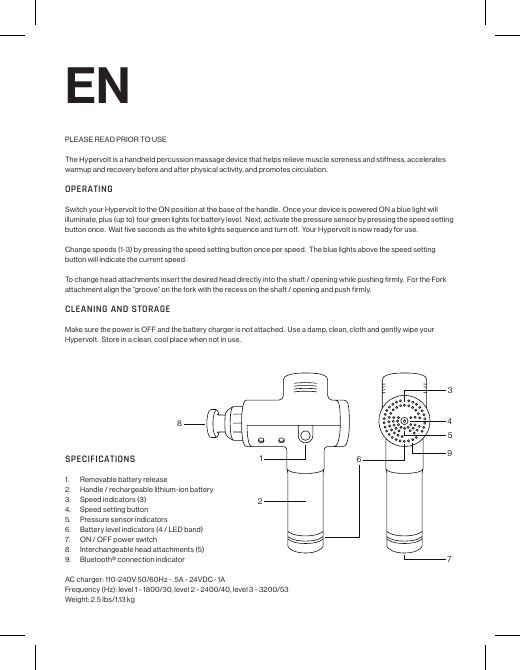
The manual describes a switch at the bottom of the battery handle, followed by a button that cycles the three levels. It shows a removable battery and an indicator for pressure feedback; Bluetooth is an optional connected feature rather than a requirement for basic operation. For attachment changes, the manufacturer says to turn the setting off, wait until the moving head stops, and then pull or insert the attachment straight into the shaft. That is a practical detail if you are identifying an older unit or assessing whether its parts are intact.
The five named heads are conventional shapes, not a special heat or air-compression attachment. The support page does not establish an exact retail-box inventory, and none of the checked model-specific support materials clearly says a carrying case or pouch was included. Those fields remain unknown—not a proven absence. A used listing may be missing heads or have a replacement kit, so match the seller's actual package rather than assuming every example retains the original set.
Runtime and charger checks
Hyperice's specification page says approximately three hours of battery life. Its operating instructions add that average runtime is 2+ hours and depends on speed and applied pressure. The difference is not an independent endurance test or a guarantee for an aging battery; it is best read as an approximate maker claim with use-dependent qualification. The manual says the battery may be removed, but the records reviewed here do not give a verified capacity in mAh.
Charging deserves more attention than the shared plug shape. The Hypervolt support specification lists a 24 V wall charger, while the original-family manual instructs use of its supplied 26 VDC adapter. Hyperice's current charger guide names the original BT and non-BT models under 24 V guidance but also notes first-generation 26 V hardware and compatibility. These are family-level directions, not a serial-specific charger label for SKU 53100 038-00, and the FAQ does not map each unit to a charger revision. Do not substitute a charger because it physically fits: read the gun and adapter labels and consult Hyperice support when the labels or provenance do not line up.
Use limits and practical fit
The safety instructions frame this as a soft-tissue device: use lightly on dry skin or over clothing, keep it moving for about a minute per region, avoid bones and the head, and stop if you feel pain or discomfort. They warn that bruising can occur and call for physician approval in listed circumstances, including pregnancy, certain complications, recent surgery or injury, implanted metal and several spinal conditions. The manual also limits continuous operation to one hour followed by at least a 30-minute rest. These are manufacturer directions, not personalized medical advice; consult a clinician about your own situation.
At a stated 2.5 lb (about 1,134 g), this is not a small travel-first tool by the site's practical grouping. The weight is a maker/manual figure, not our measurement, and no exact dimensions or verified case were found for this SKU. Compared with the later Hypervolt 2, the old Bluetooth model is heavier on the published figures (2.5 versus 1.8 lb); the newer model changes the package and power-generation details, so do not treat the similar name as an interchangeable kit. Compared with the Plus Bluetooth, the regular version has a lower listed motor wattage, body weight and dB rating, but those numbers alone do not establish which feels better or performs more effectively.
Bottom line
This record is most useful for identifying an exact Hypervolt Bluetooth 53100 038-00 and deciding whether its five listed head shapes, Bluetooth, three-level control and source-published 79 dB figure fit a comparison. Its old charger history, unresolved package contents, approximate battery claim and PPM discrepancy are meaningful cautions. Confirm the model marking, battery condition, actual heads, case contents and correct charger on the specific unit; check current official safety or recall notices before purchase. The image on this page is a diagram rendered from Hyperice's manual, not a product photograph or evidence of a particular seller's kit.
Key specifications
Key details at a glance
| Manufacturer SKU surfaced in source | 53100 038-00 |
|---|---|
| Body format | Full size |
| Device body weight (where precise enough to compare) | 1134 g |
| Speed-setting count (unknown if conflicted) | 3 |
| Heads listed in the kit | 5 |
| Heads listed in the kit | Fork / Bullet / Flat / Cushion / Round |
| Heated massage head listed in kit | No |
| Current product-page runtime claim | 180 min |
| Manufacturer dB rating present | Yes |
| USB-C charging listed | No |
| Heat built into gun body | No |
Use the exact model’s instructions for operating limits, supplied equipment and version differences.
Sources for this review
Sources for this assessment
- Hypervolt Bluetooth official declaration of conformity
- Hypervolt official US support specifications
- Hypervolt official US operating instructions
- Hypervolt official US safety instructions
- Hypervolt official multilingual product manual, English pages
- Which charger should I use with my Hyperice product?
- CPSC Recall & Product Safety Warnings search
Check the fit against your priorities
Use the finder to compare documented features, then review the exact package and caveats.